
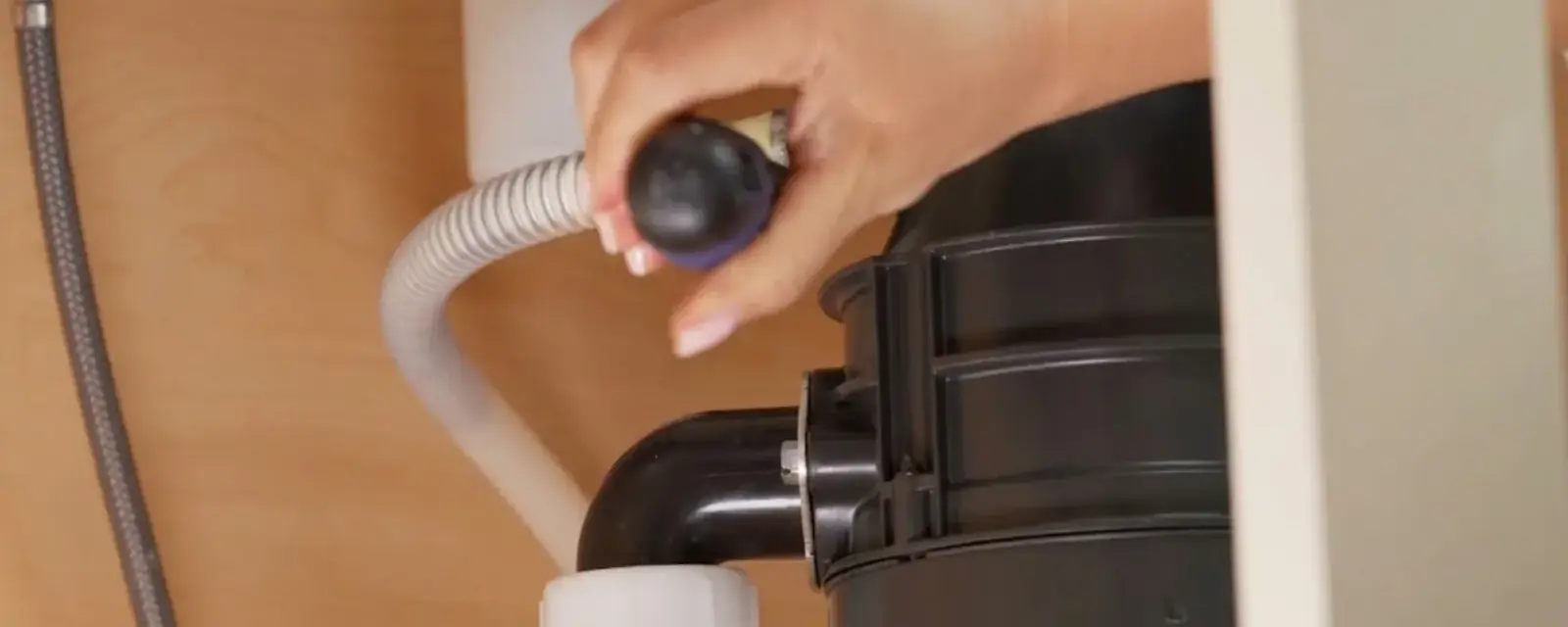
A garbage disposal sits under the kitchen sink and grinds food scraps into small pieces that flow down the drain. Plumbing one involves a mounting assembly, a drain connection, sometimes a dishwasher hose and electrical power. This guide explains how the parts fit, so you can judge whether to tackle a replacement or hire a plumber.
What you are connecting
A disposal has four connections. The top mounts to the sink flange with a three-bolt assembly. The side discharge connects to the drain trap. A side inlet, with a knockout plug, takes the dishwasher drain hose. Power comes from an outlet under the sink or a hardwired connection controlled by a wall switch.
A disposal swap is easier than a first-time install, since the sink flange, drain and power are already set up. A first-time install adds new electrical and a different drain layout.
Before you start
- Turn off power at the breaker, and confirm it is off with a tester.
- Confirm the circuit is dead with a tester.
- Clear the cabinet and put a bucket under the trap.
- Take a photo of the old setup.
- Check the new unit's size against the space under the sink.
Never reach into the disposal chamber. Use tongs or pliers to remove anything.
Step by step
- Remove the old unitDisconnect the drain, the dishwasher hose and the power. Turn the mounting ring to release the unit and lower it.
- Prepare the sink flangeIf you are replacing the flange, apply plumber's putty under it, set it, and install the mounting ring and gasket.
- Knock out the dishwasher plugIf a dishwasher connects, knock out the plug inside the disposal inlet using a screwdriver and hammer, then remove the plug piece from the chamber. This is the most commonly forgotten step.
- Wire the unitConnect black to black, white to white and the green ground to ground, following the instructions. Use the cord or cable connector supplied.
- Lift and mountHold the unit up to the mounting assembly and secure it, aligning the discharge toward the drain.
- Connect the drainAttach the discharge elbow with a gasket and connect it to the trap, making sure it slopes toward the wall pipe.
- Connect the dishwasher hoseAttach the hose to the inlet with a clamp, in a high loop or through an air gap if your sink uses one.
- TestRestore power, run water, switch the disposal on and look for leaks and dishwasher drainage.
The dishwasher hose and the high loop
Dishwashers drain through a hose that must rise high under the counter before reaching the disposal or drain. This high loop, or an air gap, keeps dirty water from flowing back into the dishwasher. Many leaks and backflow problems come from a hose that droops. Secure the hose to the underside of the counter.
Local code on air gaps varies, so check the dishwasher and sink instructions or ask the city.
Common mistakes
Forgetting the dishwasher knockout means the dishwasher cannot drain. Overtightening plastic parts cracks them. Skipping plumber's putty or the gasket leaks at the flange. Hooking up a drain with the wrong slope traps water. Working without turning off the breaker is dangerous. If anything feels uncertain, hire a plumber.
A disposal that is still leaking after a swap may have a cracked housing, a loose mounting bolt or a misaligned gasket. See drain cleaning if the sink also drains slowly, since a downstream clog loads the disposal.
Chino Hills kitchens
Chino Hills homes include many that were built after the county approved the Specific Plan in 1982, so original kitchen disposals may be due for replacement. The City of Chino Hills lists work that requires a permit on its website. Plumbing changes beyond a simple disposal swap, such as moving the sink or changing the drain layout, may need one, so ask the city's Building and Safety Division with your address.
The city supplies water from a blend of sources, so scale on seals and gaskets can vary by home. If you see white buildup at the sink flange, check it during the swap.
Choosing a disposal
- Horsepower matters for heavy use. Larger households do better with more power.
- Continuous feed is common, while batch feed runs only with the stopper in place.
- Noise insulation varies by model.
- Check the warranty and what it covers.
- Confirm the mounting system fits your sink.
For a deeper look at disposal faults, see our garbage disposal repair page.
Electrical safety and the wall switch
Most disposals plug into an outlet under the sink or are hardwired to a junction box. Either way the unit needs its own switch, usually on the wall near the sink. Turn the breaker off before you touch a wire, then test the wires with a non-contact tester.
If the cable is damaged, the box is crowded or you are not comfortable with wiring, stop here. Hiring an electrician or a plumber who handles the connection costs little compared with a shock or a fire.
After the swap: a quick leak check
Run the disposal with cold water for a minute, then check every joint with a dry paper towel. Check again after the dishwasher runs a full cycle. A slow drip at the flange often shows up only after the putty cures, so look again the next day.
Keep cold water running while the disposal grinds. That flushes particles through the trap and keeps the motor cooler. Avoid grease, fibrous scraps such as celery strings, and large bones, which are the usual cause of jams and slow drains.
Frequently asked questions
A disposal needs a way to turn it on. Many use a wall switch, and some use an air switch on the counter. Follow the instructions and local rules.
The knockout plug was probably left in the inlet. Remove it from inside the chamber.
Check the sink maker's limits. A stainless sink is usually fine, and a thin or stone sink may need support.
The drain system needs venting, and the disposal connects to the same trap and vent as the sink. A plumber can check the setup.
A slow drip can wait, but a stream under the sink is urgent. Close the water and call.
When to hire a plumber for the swap
Hire help if the sink flange is corroded, if the drain layout needs changing, if the cabinet has no outlet or if the old unit is stuck. A plumber can also check the dishwasher air gap and the trap while the cabinet is empty. The extra visit time is small compared with the cost of fixing a leak in the cabinet.
For coverage, see Chino plumbing coverage and our service area.
Standards for disposal installs
The drain side follows the California Plumbing Code, which is based on the Uniform Plumbing Code (UPC), and the wiring follows the National Electrical Code (NEC). If either side is unfamiliar, hire a licensed plumber or electrician.