
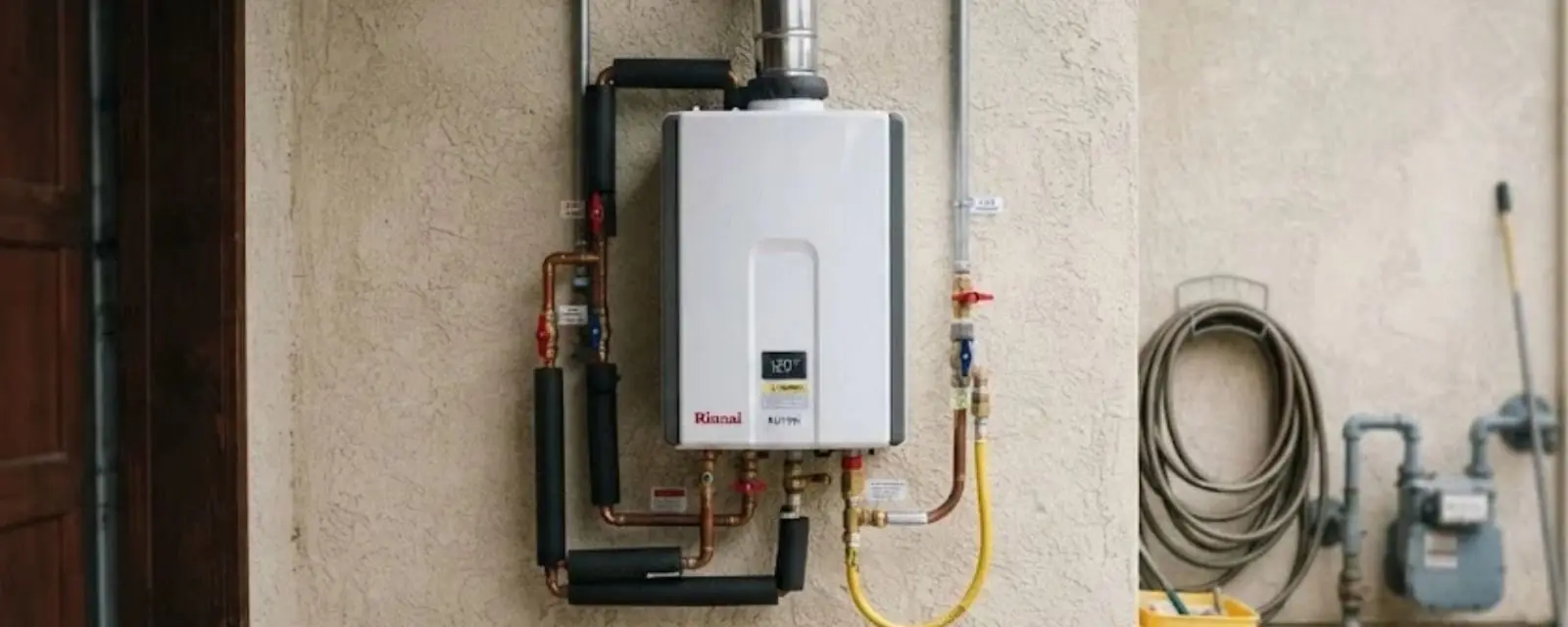
A tankless water heater leaks for a handful of reasons, and where the water appears tells you most of what you need to know.
Water at a pipe connection is usually a loose or worn fitting. Water from inside the cabinet can mean a cracked heat exchanger. Water dripping from the relief valve means pressure or temperature is too high. First shut off the cold water to the unit, turn off the gas or power, and then work out which of these you have.
Do this before anything else
Close the cold water isolation valve at the bottom of the heater. Turn the heater off at its switch or breaker and close the gas valve if it is a gas model. Put a towel and a bucket under the leak. Take a photo of the unit and the wet area, because it helps the plumber and any insurance conversation.
Do not open the cabinet while the unit is powered. A leak near wiring or a control board is a shock risk.
Where the leak is and what it means
| Where the water is | Likely cause | Who handles it |
|---|---|---|
| Pipe connections underneath | Loose fitting, worn washer or failed isolation valve | Often a plumber's quick fix |
| Relief valve discharge | Pressure or temperature too high, or a worn valve | Plumber, as soon as possible |
| Inside the cabinet, near the exchanger | Cracked or corroded heat exchanger | Plumber, usually replacement |
| Condensate drain line (high efficiency units) | Blocked drain or neutralizer | Plumber or service tech |
| Vent pipe | Condensation or a bad joint | Plumber, check the slope |
Common causes in detail
Worn washers and loose fittings are the cheapest fix. The water, gas and hot outlet connections all use washers that harden over time. Isolation valves also wear, and a leaking valve stem is a routine replacement.
Scale is the next big cause. Hard water leaves mineral buildup inside the heat exchanger, which restricts flow and raises temperature at the metal. Over time the exchanger can crack. Flushing the unit with a descaling solution on the schedule in your manual slows that damage. See tankless water heater for what service involves.
Freezing is rarely an issue in this part of California, but a unit mounted outside can still be damaged by an unusual cold snap if it lacks freeze protection.
When it is a repair and when it is a replacement
If the leak is at a connection or a valve, repair is straightforward. If the heat exchanger is cracked, the repair is often as costly as a new unit, and the age of the heater decides. The U.S. Department of Energy says tankless water heaters typically last more than 20 years with proper maintenance, so a leak in a young unit is usually worth repairing under warranty.
Check your warranty before calling anyone to open the unit. Some manufacturers require a licensed plumber or a certified installer for the warranty to stay valid.
Chino Hills tankless heaters and the permit
The City of Chino Hills lists water heater replacement among the work that needs a permit, so swapping a tankless unit is not a casual job. Ask your plumber who pulls the permit before a replacement begins. State law, under Health and Safety Code section 19211, requires bracing for water heaters, and a plumber should check that any new or moved unit is mounted to code.
Water in Chino Hills comes from several sources, including treated surface water and groundwater. Hardness varies, so test your own tap and descale on your manual's schedule.
Flushing and maintenance that prevent leaks
Flush the heat exchanger once a year or on the schedule your manufacturer gives. Use a descaling solution and a small pump, run it through the unit and rinse well. Clean the inlet water filter screen at the same time.
Check the condensate drain on a high efficiency model. A blocked drain can back water into the cabinet. Replace the neutralizer cartridge if your model has one. A yearly service visit also catches loose fittings before they leak.
Should you keep using it
If water is dripping at a fitting and the unit still works, you can keep it off until a plumber looks at it. Do not run a unit that leaks inside the cabinet or at the relief valve. Water on a hot heat exchanger or an electrical board is not worth the risk, and a cheap repair can become an expensive one if water reaches the control board.
For service in the Chino area, see Chino plumbing coverage and our service area.
What the plumber will check on arrival
A plumber starts by confirming the leak is coming from the heater and not from a nearby pipe. Condensation on a cold pipe above the unit can look like a leak. The plumber dries everything, runs the unit and watches where the first drop forms.
Next comes a pressure check. High water pressure stresses fittings and can make the relief valve drip. A small gauge on a hose bib reads it in seconds. If pressure runs high, a pressure regulator or an expansion tank may be part of the fix.
Then the plumber looks at the error code on the display. Most tankless units log a fault code that points to flow, ignition or temperature problems. Write down any code before you power the unit off, since it helps a technician diagnose the issue.
Parts that wear out first
Isolation valves are the usual weak point, since they open and close during flushing. Inlet filter screens clog and cause pressure swings. Condensate traps on high efficiency models fill with debris. Flow sensors fail and cause cycling, which wears seals.
A routine service visit replaces or cleans these parts for far less than an emergency repair, and it keeps the warranty valid when the manufacturer requires proof of maintenance.
Why a small drip should not wait
A slow drip at a fitting can run for months and look harmless. Over that time it can corrode the connection, stain the wall and feed mold behind the unit. Water running down the back can reach electrical parts and shut the heater down at the worst moment. A quick repair when the drip begins avoids a bigger bill later.
Frequently asked questions
Water spraying or pooling is urgent. Shut off the water and the power or gas and call. A slow drip at a fitting can wait for a planned visit.
Bottom leaks are usually at the water or gas connections, the isolation valves or the condensate line. A plumber can find which in a few minutes.
Yes. Mineral buildup stresses the heat exchanger and can lead to cracks over time. Descaling on schedule slows that damage.
The City of Chino Hills lists water heater replacement as permit work. Ask the Building and Safety Division about your address.
It depends on the part and who installed it. Check the warranty terms and the installation date before work begins.
What to have ready for the call
Have the model and serial number, the install date and a photo of the leak. Note any error code on the display. Say how long the leak has been going on and whether the water is hot or cold. With that information, a plumber can often bring the right part on the first visit.
Codes that apply to tankless units
Tankless installation follows the California Plumbing Code, which is based on the Uniform Plumbing Code (UPC), along with the manufacturer's installation instructions. The manual is the standard that governs your warranty, so keep it with your records.