
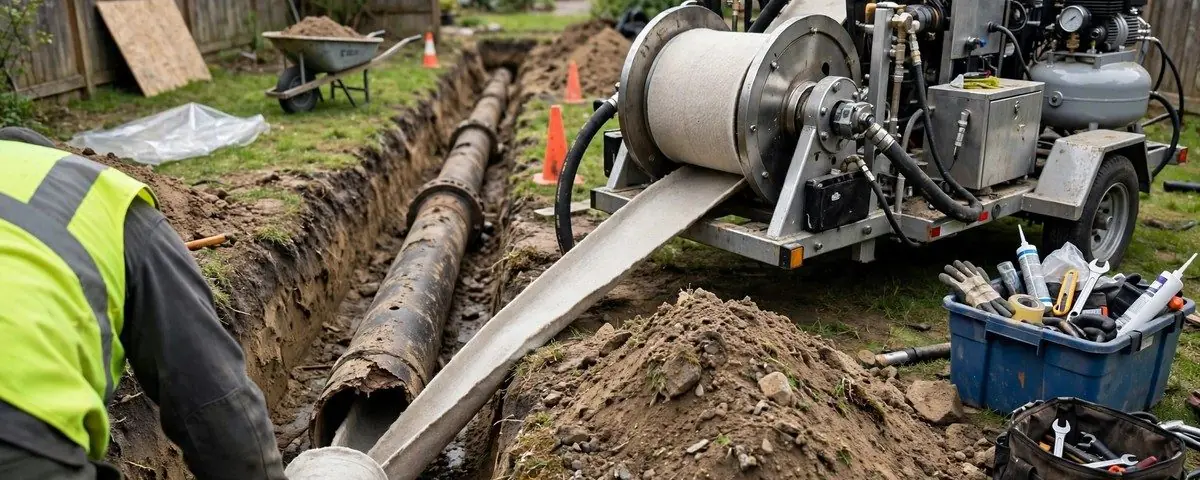
Trenchless pipe lining repairs a damaged sewer line from the inside, so the yard is not dug up along the whole run. A resin-soaked liner is pulled or inflated into the old pipe and hardens into a new pipe within the old one. It is a good option for some problems and a poor one for others. This guide explains how it works, what it can fix and how to decide with a camera inspection in hand.
How lining works
First the pipe is cleaned so the liner can bond. A camera then confirms the damage. A flexible liner coated with epoxy resin is inserted through an access point, pushed into place and pressed against the old pipe wall. The resin cures with heat, water or light, and the result is a smooth, jointless inner pipe. A final camera run confirms the lining and the plumber reopens any side connections.
The access is usually a cleanout or a small excavation at each end. That is why the method is called trenchless, even if a small hole is dug.
What lining fixes and what it does not
| Problem | Lining | Other option |
|---|---|---|
| Small cracks and root entry | Good fit | Spot repair |
| Corroded or scaled pipe | Good fit | Replacement |
| Collapsed pipe | Not suitable | Dig and replace or pipe bursting |
| Large belly that holds water | Not fixed | Replacement with correct slope |
| Misaligned or separated joints | Depends on severity | Spot repair or replacement |
Lining restores the pipe wall, but it does not correct slope. A sagging section will still hold water after lining, because the liner follows the old pipe's shape.
The role of the camera
Never approve lining without a recent video of the line. Cleaning and a camera pass show whether the pipe is intact enough to take a liner. A pipe with a collapse or a major offset may block the liner. See sewer inspection for how that step works.
Ask for the footage and a note of the distance to each defect. A reputable plumber shows you the problem and explains why lining or digging suits it.
Pipe bursting as an alternative
Pipe bursting pulls a new pipe through the old line while breaking the old one apart. It needs access pits at each end, and it can replace a pipe that has collapsed or lost slope in places. Compared with open trench replacement, both trenchless methods usually mean less damage to lawns, driveways and landscaping.
Ask which method fits your line and why. Your plumber should explain the limits of each, and the benefits.
Chino Hills lines and permits
Chino Hills homes include areas that began as a canyon summer resort in Sleepy Hollow, with about 90 cabins by 1928, and Los Serranos, which grew around a golf club that opened in 1925. Older neighborhoods can have older sewer lines, which is why a camera look matters before a repair choice.
Sewer repairs usually involve city rules and sometimes a permit. Ask your plumber how the work will be permitted with the City of Chino Hills, and confirm the plumber holds a C-36 license from the Contractors State License Board.
Questions to ask before approving
- Can I see the camera footage and the distance to the damage?
- Is the pipe suited to lining, and why?
- What is the liner material and its warranty?
- Who handles the permit and the final video?
- What happens at the connections and the cleanouts?
For the full repair path, see sewer line repair. For coverage, see Chino plumbing coverage and our service area.
What the process looks like day to day
On the day of the job, the crew sets up access at a cleanout or at a small excavation. They clean the pipe with a cutter or a jetter, run a camera, and cut off any protruding roots. Then they prepare and insert the liner, cure it and run a final video. Most single-line residential jobs can be done in a day or two, though larger runs take longer.
Water use is limited while the liner cures, so plan showers and laundry around the crew. Ask how long the cure takes and when you can use the plumbing again.
Costs and what changes the price
Price depends on the length of the line, the depth, the number of access points, the pipe diameter and how much cleaning the pipe needs. Lining usually saves landscaping, driveway and hardscape repair costs compared with open trenching, which can make it competitive even when the lining itself costs more.
Get at least two written quotes that list the same scope. Compare the liner material, the warranty and what happens at the connections.
Limits and honest risks
Lining reduces the inner diameter slightly. A thick liner in a small pipe can reduce flow, so the installer should confirm the new diameter still handles the load. Lined pipes still depend on the connections at each end, which may need separate repair. A poor cure or a rushed prep can leave wrinkles or voids, so ask for the final camera run and keep the video.
If a plumber says lining fits every case, ask for the camera proof.
Frequently asked questions
It depends on the product and the installation. Ask the installer for the manufacturer's stated lifespan and warranty in writing.
No. Collapsed pipes, severe offsets and sagging sections may need replacement.
It depends on the length, depth and what is above the pipe. Ask for options and quotes in writing.
A sealed liner blocks root entry through cracks and joints, though roots can still press on the pipe.
Sewer work may need one. Ask the City of Chino Hills Building and Safety Division about your address.
Preparing your property
Mark sprinkler lines and tell the crew about any known obstacles, such as old tree roots or a shared driveway. Clear access to the cleanout. Avoid heavy water use while the crew works. If you have pets, keep them away from the work area.
Ask the plumber to photograph the access points before and after. Keep the final video with your home records.
Standards behind lining
Liners installed by inversion and cure follow ASTM F1216, and the repair falls under the California Plumbing Code, which is based on the Uniform Plumbing Code (UPC). Ask the installer which standard the liner meets and for the warranty in writing.